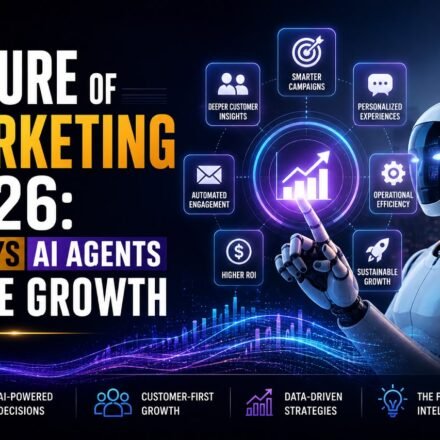















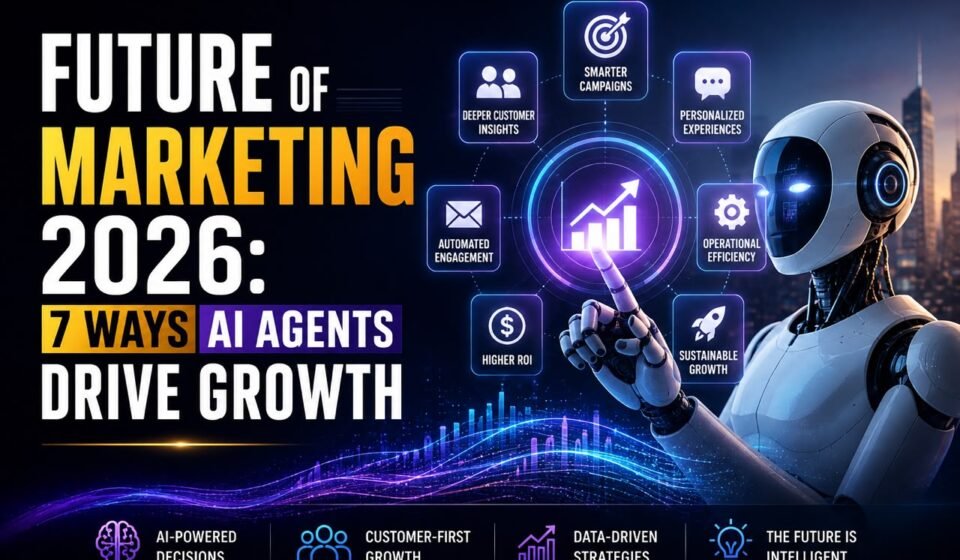

Explore the future of marketing in 2026 with 7 proven ways AI agents in marketing drive growth. Discover key AI marketing trends, strategies, and innovations shaping digital success.
There was a time when marketing meant doing everything yourself.
- You researched your audience.
- You wrote the content.
- You created the campaign.
- You checked the numbers.
- You answered messages.
And when the day finally ended, you realized there were still ten more things waiting for you tomorrow.
For many business owners and marketers, that reality hasn’t changed much. But something is changing quietly in the background.
Artificial intelligence is no longer just helping marketers complete individual tasks. In 2026, we’re entering a new phase where AI agents can actually take responsibility for parts of the marketing process.
And that’s a much bigger deal than simply asking an AI tool to write a social media caption.
Imagine having an assistant that notices your website traffic has dropped, investigates why, identifies the pages losing visitors, suggests new content, creates a campaign, monitors the results, and adjusts the strategy based on what happens.
That’s the promise of AI agents, they don’t simply give you an answer, they can observe, decide, act, and learn from the results and for small businesses especially, this could change the game.
A company that once needed an entire marketing team to manage dozens of daily tasks may increasingly be able to accomplish more with a much smaller team supported by intelligent AI agents.
So, what exactly is changing?
Let’s explore seven ways AI agents are transforming marketing in 2026.
- AI Agents Are Turning Marketing Into a 24/7 Operation:
One of the biggest challenges in marketing has always been consistency.
You might have great ideas on Monday, but by Thursday you’re exhausted.
You planned to publish three posts this week, but client work got in the way.
You wanted to follow up with potential customers, but there simply wasn’t enough time. AI agents are beginning to change that.
Instead of waiting for a human to initiate every task, an AI agent can be given a goal and a set of rules to work within.
For example:
“Monitor our website traffic every morning and alert me if organic traffic drops by more than 15%.”
That’s different from simply asking an AI chatbot, “Why did my traffic fall?” The agent can monitor the situation continuously and bring the problem to your attention.
This creates something marketers have always wanted but rarely had:
a marketing operation that doesn’t completely stop when you step away and there’s something powerful about that.
- You don’t have to be online every minute to keep your marketing moving.
- You can sleep.
- You can spend time with your family.
- You can work on the bigger picture.
Meanwhile, automated systems can continue handling repetitive monitoring and execution. The goal isn’t to replace the human marketer.
It’s to give the human marketer more room to think.
- AI Agents Are Making Personalization Much More Powerful:
We’ve been hearing about personalized marketing for years.
“Hi Sarah” in an email isn’t really personalization anymore.
Customers expect businesses to understand their interests, behavior, problems, and preferences. The challenge is that doing this manually at scale is incredibly difficult. AI agents can help bridge that gap.
Imagine an online store with thousands of customers, Instead of sending everyone the same promotional email, an AI system could analyze customer behavior and identify different patterns.
- One customer may have viewed running shoes three times.
- Another may have abandoned a cart containing fitness equipment.
- Someone else may have purchased a product six months ago and is now likely to need a replacement.
Each person represents a different opportunity.
AI agents can help marketers respond to those differences automatically.
That could mean recommending different products, adjusting messaging, changing the timing of communications, or triggering a follow-up campaign.
The result is marketing that feels less like:
“We’re sending this to everyone.”
And more like:
“We understand what you’re looking for.”
That difference matters.
Because people don’t want to feel like numbers in a database, they want to feel understood.
- AI Agents Are Changing Content Creation:
Content marketing has always had a painful problem. There are endless things to create, but only so many hours in a day.
- Blog posts.
- Emails.
- Social media content.
- Videos.
- Ads.
- Landing pages.
- Newsletters.
- Product descriptions.
The list never ends.
AI agents can now help connect many of these pieces together.
Instead of simply asking AI to write one blog post, marketers can build workflows where an agent helps research a topic, identify questions customers are asking, develop content ideas, create drafts, repurpose content for different platforms, and monitor how the content performs.
Think about what that means for a small business owner.
Someone who once struggled to publish once a week could potentially build a system that keeps their content pipeline moving consistently.
But there’s an important warning here, more content doesn’t automatically mean better marketing.
The internet is already flooded with generic AI-generated content. If everyone uses AI to say the same things in the same way, audiences will eventually stop paying attention.
That’s why human creativity becomes even more important.
AI can help you produce faster but your experiences, opinions, stories, and understanding of your audience are what make the content worth reading.
The future won’t belong to businesses that simply create the most content. It will belong to businesses that create content people actually care about.
- AI Agents Are Becoming Marketing Analysts:
Marketing data can be overwhelming, you open your analytics dashboard and see hundreds of numbers.
- Traffic.
- Clicks.
- Conversions.
- Bounce rates.
- Engagement.
- Customer acquisition costs.
- Revenue.
And somewhere inside all those numbers is the information you actually need. The problem is finding it.
AI agents can help marketers move from simply collecting data to actually understanding it. Instead of staring at a dashboard wondering what happened, an agent could monitor performance and identify unusual changes.
For example:
“Your Facebook campaign generated 23% fewer conversions this week.”
But it doesn’t have to stop there.
It can potentially investigate further:
“The decline appears to be coming primarily from one audience segment, while your other audiences remain stable.”
Now you have something useful, you have a direction to investigate.
This is where AI becomes more than an analytics tool. It becomes a marketing partner that helps you ask better questions.
And sometimes, finding the right question is more valuable than having another hundred statistics.
- AI Agents Are Improving Customer Relationships:
Customer service has always been part of marketing, a great advertisement may attract someone but the experience afterward determines whether they stay.
AI agents are increasingly being used to help businesses respond to customers faster and provide assistance across different stages of the customer journey.
Someone visits your website at midnight.
They have a question.
Your team is asleep.
An AI-powered system can potentially answer basic questions immediately, guide the customer toward useful information, or collect details for a human representative to follow up later.
That speed can make a difference but businesses need to be careful. customers don’t want to feel trapped in conversations with machines.
There are moments when empathy, judgment, and human understanding matter.
A frustrated customer doesn’t always need a perfectly optimized response. Sometimes they simply need someone to listen.
That’s why the strongest AI-powered customer experiences will likely be the ones that know when to automate and when to hand the conversation back to a human.
Technology should make relationships easier. It shouldn’t make them colder.
- AI Agents Are Making Advertising More Adaptive:
Digital advertising has always involved testing.
- Different headlines.
- Different images.
- Different audiences.
- Different landing pages.
- Different offers.
But traditional testing can take time, especially for small businesses with limited budgets.
AI agents can help marketers monitor campaigns and identify which combinations are performing better.
Instead of launching a campaign and checking it days later, marketers can increasingly use intelligent systems to watch performance continuously and recommend or execute adjustments within predefined boundaries.
Imagine spending $500 on a campaign.
Instead of discovering two weeks later that most of your budget went toward an audience that wasn’t converting, an AI-powered system could identify the weak performance much earlier.
The opportunity here isn’t simply saving money. It’s learning faster and in marketing, speed of learning can become a serious competitive advantage.
The businesses that learn what their customers want faster can often adapt faster.
- AI Agents Are Giving Small Businesses Something They Never Had Before:
This might be the most exciting part. For years, large companies had an advantage because they could afford large teams.
- They had strategists.
- Data analysts.
- Copywriters.
- Designers.
- Media buyers.
- Customer support teams.
- Marketing operations specialists.
A small business owner might have been doing all of those jobs alone. AI agents won’t magically eliminate that gap but they can begin to narrow it.
A small business with a smart marketing system can potentially accomplish tasks that previously required several people.
That doesn’t mean one person can suddenly run a Fortune 500 company alone. It means the economics of marketing are changing.
A talented entrepreneur with the right strategy and the right AI systems may be able to compete with businesses that have significantly larger resources.
And that is where this technology becomes more than a trend, It becomes an opportunity.
The Human Marketer Isn’t Disappearing, Whenever a new technology arrives, people ask the same question:
“Will AI replace us?”
I think the better question is:
“What will people who know how to work with AI be able to accomplish?”
That’s where the real opportunity lies.
AI agents can process information quickly.
- They can monitor campaigns.
- They can recognize patterns.
- They can automate repetitive tasks.
- They can help execute strategies.
- But they don’t have your childhood memories.
- They don’t know the moment you realized why you started your business.
- They haven’t sat across from your best customer and listened to their story.
- They haven’t experienced your failures.
- They haven’t felt the pressure of trying to make payroll.
- They don’t understand your brand the way you do unless you teach them and those human experiences are incredibly valuable.
Marketing has always been about people. AI is simply giving us new ways to understand and reach them.
The Biggest Mistake Businesses Can Make in 2026
The biggest mistake isn’t using too little AI. It’s using AI without a strategy.
Some businesses are rushing to add AI to everything.
- They generate content because they can.
- They automate messages because they can.
- They build workflows because the technology makes it possible.
- But automation without purpose can create more noise instead of more value.
Before giving an AI agent a task, ask yourself:
- What problem am I trying to solve?
- Will automation improve the customer experience?
- What should remain human?
- How will I measure success?
Those questions matter more than the technology itself. Because the businesses that win with AI won’t necessarily be the ones using the most tools.
They’ll be the ones using technology with the clearest purpose.
Final Thoughts
We’re standing at an interesting moment in marketing. For years, we’ve talked about artificial intelligence as something that might change the future.
Now the future is showing up in our everyday workflows.
AI agents are beginning to move marketing from simple automation toward something much more intelligent.
- They can watch.
- They can analyze.
- They can recommend.
- They can execute.
And, when designed properly, they can continuously improve how businesses communicate with their customers.
But there’s one thing I don’t want marketers to forget.
- Don’t let technology make your marketing lose its humanity.
- People still connect with stories.
- They still remember kindness.
- They still trust authenticity.
- They still want to know that there’s a real person behind the brand.
So use AI.
- Experiment with it.
- Build smarter systems.
- Automate what wastes your time.
- But keep your voice.
- Keep your story.
- Keep your humanity.
Because in a world where AI can create almost anything, being genuinely human may become one of the most valuable things a brand can offer.
And this is only the beginning.
In the next chapter of AI marketing, the businesses that succeed won’t simply ask what AI can do for them.
They’ll ask a much bigger question:
What could we accomplish if humans and AI worked together?