

















Discover how ChatGPT Ads are changing digital marketing in 2026. Learn how AI advertising works, what marketers need to know, and how to adapt.
Imagine this, you’re sitting on your couch, holding your phone, trying to decide which laptop to buy.
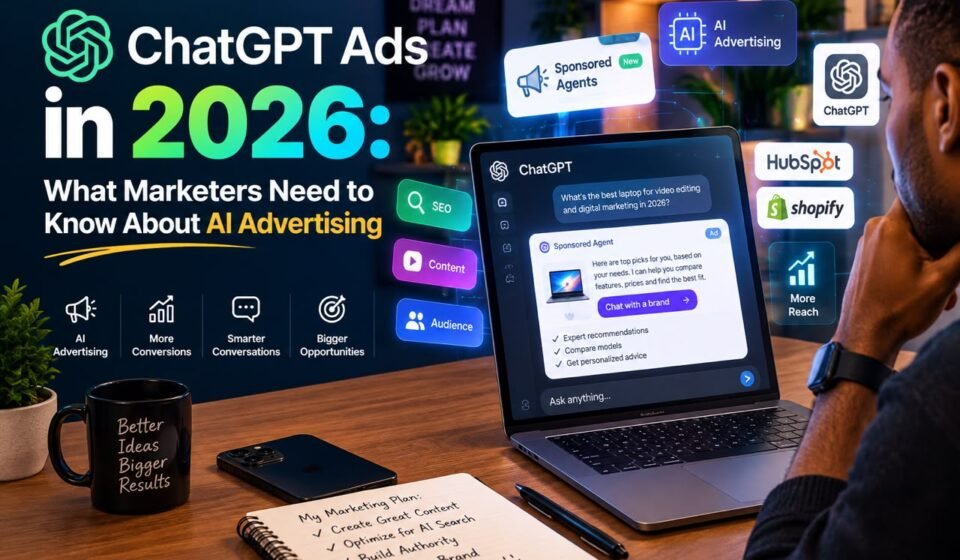
Instead of opening Google and clicking through ten different websites, you ask ChatGPT:
“What laptop should I buy for video editing and digital marketing?”
You have a conversation. You ask another question. Then another.
And suddenly, inside that conversation, you see an advertisement from a company.
But this isn’t just a normal banner ad.
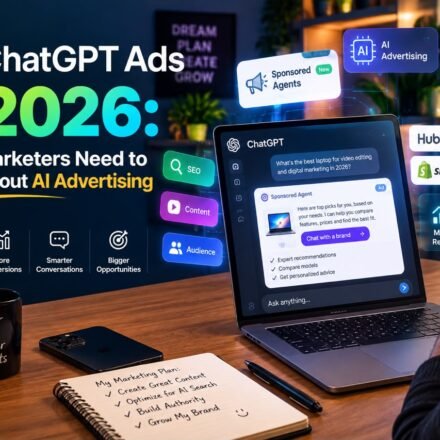
You can click it and start talking directly with an AI agent sponsored by that business.
That might sound like something from the future.
But on September 16, 2026, OpenAI announced that it is testing exactly this kind of experience through what it calls Sponsored Agents. (OpenAI) and honestly, if you work in digital marketing, you should be paying attention.
Because the way people discover businesses online is changing again.
Welcome to the Next Chapter of Digital Marketing
For years, digital marketing followed a familiar pattern.
- You searched Google.
- You saw advertisements.
- You clicked a website.
- You read the offer.
- Maybe you bought something.
- Then social media changed the game.
People started discovering products on Facebook, Instagram, TikTok and YouTube without actively searching for them.
Now AI is creating another shift.
People aren’t only searching anymore.
- They’re asking.
- They’re asking ChatGPT what to buy.
- They’re asking what software to use.
- They’re asking which restaurant to try.
- They’re asking how to solve business problems.
- They’re asking AI to compare products, explain complicated topics and help them make decisions.
- That changes something incredibly important for marketers:
- The conversation itself is becoming part of the customer journey.
And that’s where ChatGPT advertising becomes interesting.
What Exactly Is a ChatGPT Sponsored Agent?
OpenAI says it is testing a new advertising format called Sponsored Agents.
Here’s the simple version.
A person sees an advertisement inside ChatGPT. If they choose to interact with it, they can start a conversation with an AI agent sponsored by the business.
The conversation is clearly labeled and kept separate from ChatGPT’s independent answers and the user’s original conversation. The user can ask questions and eventually visit the advertiser’s website. (OpenAI)
Think about that for a second.
Traditional advertising usually says:
“Buy this.”
Sponsored AI experiences can potentially say:
“Tell me what you’re looking for, and I’ll help you understand whether this product is right for you.”
That’s a very different experience.
Instead of sending someone from an advertisement straight to a landing page, the interaction can become conversational and conversations are powerful.
Why This Matters to Digital Marketers
Here’s where things get interesting for people like you and me who spend time thinking about online marketing.
We’ve spent years learning how to write better advertisements.
- Better headlines.
- Better hooks.
- Better landing pages.
- Better calls to action.
- Better targeting.
But AI is beginning to add another layer.
What happens after someone becomes interested?
Imagine you’re selling fitness equipment. Someone sees your sponsored ad in ChatGPT. Instead of immediately sending them to a product page, they could potentially interact with a sponsored AI agent and ask:
“Will this treadmill fit in a small apartment?”
“How much weight can it support?”
“Is it good for beginners?”
“What is the difference between this model and the cheaper one?”
The customer gets answers.
The business gets another opportunity to communicate and the website becomes the next step instead of necessarily being the first step.
That’s a major change in how we should think about online advertising.
ChatGPT Ads vs. Traditional Advertising
This doesn’t mean Google Ads, Meta Ads or other advertising platforms suddenly disappear.
“They don’t”.
Instead, marketers now have another environment to understand.
Traditional advertising often interrupts someone’s activity.
- You’re scrolling Instagram. An ad appears.
- You’re watching YouTube. An ad appears.
- You’re searching Google. Sponsored results appear.
AI advertising can potentially fit more naturally into a conversation where the person is already asking questions about a problem or product.
That’s what makes this development so interesting.
The person is already expressing an intention.
They’re already looking for information.
And marketers are trying to meet them inside that journey.
AI Is Also Changing How Businesses Create Ads
There’s another part of OpenAI’s announcement that marketers should pay attention to.
OpenAI says it is introducing tools that make it easier for advertisers to create ads using natural-language prompts in ChatGPT Work.
It is also adding new AI creative capabilities to Ads Manager. (OpenAI)
Think about what that means for a small business owner.
- You might not have a massive advertising department.
- You might not have a copywriter.
- You might not have a graphic designer sitting beside you.
- You might simply have an idea.
- You could potentially explain what you’re selling, who you’re trying to reach and what you want the campaign to accomplish.
AI can then help turn that information into advertising assets. we’re moving closer to a world where the barrier between “I have a business idea” and “I can create a marketing campaign” becomes much smaller.
Small Businesses Should Pay Attention
This part is especially important.
- You don’t need to be Coca-Cola.
- You don’t need millions of dollars.
- You don’t need a marketing department with 20 people.
A small business can have a website, a product and a clear message.
AI can increasingly help with:
- Ad copy
- Creative ideas
- Customer questions
- Product descriptions
- Email campaigns
- Social media content
- Audience research
- SEO
- Customer support
- Marketing strategy
That doesn’t mean AI will automatically make a business successful.
It won’t. But it can reduce the amount of time and resources required to get marketing work done and for a small business fighting for attention online, that matters but Don’t Make This Mistake
There’s something I want you to remember.
Don’t hear “AI advertising” and immediately think you need to spend money on ChatGPT Ads.
That’s not the lesson.
The bigger lesson is understanding where customers are going.
If people increasingly use AI to discover information, products and businesses, marketers need to understand how their brands appear in those conversations.
That means your website still matters.
- Your content still matters.
- Your reputation still matters.
- Your product still matters.
- your ability to answer real customer questions matters more than ever.
AI doesn’t magically fix a bad business.
It amplifies what is already there.
- If your website is confusing, AI can’t save your customer experience forever.
- If your product doesn’t deliver, better advertising won’t solve the underlying problem.
- If your content provides no useful information, simply adding the word “AI” to it won’t make it valuable.
What Should Marketers Start Doing Now?
If you’re a digital marketer reading this, don’t panic.
You don’t need to completely throw away everything you’ve learned.
Instead, start adapting.
- Create content that answers real questions:
- Stop writing only for keywords.
- Start writing for people.
Think about the questions your customers actually ask.
If you sell laptops, answer:
“What’s the best laptop for video editing under $1,000?”
If you sell marketing services, answer:
“How much should a small business spend on Facebook advertising?”
If you sell fitness products, answer:
“What equipment do I need to start working out at home?”
These questions are valuable because they’re connected to real customer intent.
- Make your website easy for AI and humans to understand:
Your website shouldn’t leave visitors confused.
Clearly explain:
- What you sell
- Who it’s for
- How it works
- How much it costs
- Why someone should consider it
- How they can contact you
Simple doesn’t mean boring.
Simple means understandable.
- Build authority:
If you want your business to be discovered through AI-powered search and recommendations, don’t just publish endless generic articles.
- Share genuine expertise.
- Show examples.
- Explain your experiences.
- Answer difficult questions.
- Create original research when possible.
- Build a website that actually deserves to be mentioned.
- Don’t abandon traditional marketing:
This is important.
- Don’t stop using SEO because AI exists.
- Don’t stop building your email list.
- Don’t stop creating social media content.
- Don’t stop improving your website.
- Don’t stop learning paid advertising.
Instead, think about AI as another layer of your marketing strategy.
The strongest marketers won’t necessarily be the people who abandon everything old.
They’ll be the people who understand how the pieces fit together.
The Human Side of AI Marketing
There’s something else we shouldn’t forget. Marketing has always been about people.
- Technology changes.
- Platforms change.
- Algorithms change.
But people still have problems.
- People still have dreams.
- People still worry about wasting money.
- People still want to feel understood.
That’s why I believe the marketers who rely entirely on automation could eventually run into trouble.
AI can generate words. But understanding people is different, you still need to know what your customer is feeling.
- What keeps them awake at night?
- What are they afraid of?
- What do they want?
- Why haven’t they bought yet?
- What would make them trust you?
Those questions are human and that’s where marketers still have enormous value.
The Future of Advertising May Feel More Like a Conversation
This is the part I find most fascinating.
For decades, advertising has mostly been about grabbing attention.
- A billboard.
- A banner.
- A commercial.
- A sponsored post.
- A search ad.
But AI introduces another possibility.
What if advertising becomes a conversation?
Instead of:
“Here is our product.”
It becomes:
“What are you trying to accomplish?”
Instead of:
“Click here.”
It becomes:
“Tell me what you’re looking for.”
Instead of:
“Buy now.”
It becomes:
“Let me help you decide whether this is right for you.”
That’s a very different relationship between a brand and a customer and Sponsored Agents are an early example of where this could be heading.
What About SEO?
This is where things get particularly interesting for website owners.
For years, the goal was simple:
Get to page one of Google but AI-powered search is creating another question:
Will AI systems understand and recommend my business when someone asks a relevant question?
That means marketers need to think beyond rankings.
- You need useful content.
- You need clear information.
- You need trustworthy sources.
- You need a strong brand.
- You need a website that answers questions rather than simply stuffing keywords onto pages.
- You need to understand how people search differently when they’re talking to an AI assistant.
The search box is becoming more conversational, your content needs to become more helpful too.
There Are Still Questions It’s important not to get carried away.
Sponsored Agents are currently being tested with select advertisers in the United States, so marketers shouldn’t assume that every business can immediately use the feature everywhere. (TNW)
And because this is still developing, we don’t yet know exactly how the advertising ecosystem will evolve.
There will likely be questions around user experience, transparency, measurement, targeting and how businesses make sure sponsored interactions remain genuinely useful.
Those questions will become increasingly important as conversational advertising develops.
My Takeaway for Marketers
If you’ve been waiting for the “perfect time” to learn AI marketing, I honestly wouldn’t wait.
Not because you need to chase every new AI tool and definitely not because every new feature will become a massive success.
Learn because the behavior of internet users is changing.
People are moving from:
Search → Click → Website
toward more conversational journeys like:
Question → AI conversation → Recommendation → Decision → Website
That’s a big shift and we’re still very early.
The marketers who pay attention now will at least understand what’s changing while everyone else is still wondering why their old strategies aren’t producing the same results.
Final Thoughts
A few years ago, if you told me that people would ask an AI chatbot what product they should buy, I’d probably have thought you were describing a science-fiction movie.
Today, millions of people use AI to help them write, research, compare, learn and make decisions and now advertising is moving deeper into that conversation.
OpenAI’s September 16 announcement about Sponsored Agents and its new advertising tools is another sign that the relationship between AI, advertising and customer discovery is evolving quickly. (OpenAI)
So don’t just ask:
“How can I advertise with AI?”
Start asking a bigger question:
“How can I build a business that people—and the AI tools helping them—can actually understand and trust?”
Because technology will continue changing.
The platforms will change.
The algorithms will change.
But businesses that understand their customers, solve real problems and communicate clearly will always have something valuable to offer.
And that, more than any individual AI tool, is where I believe the real opportunity is.
The future of digital marketing isn’t simply about getting someone’s attention.
It’s about becoming useful at the exact moment they’re looking for an answer.