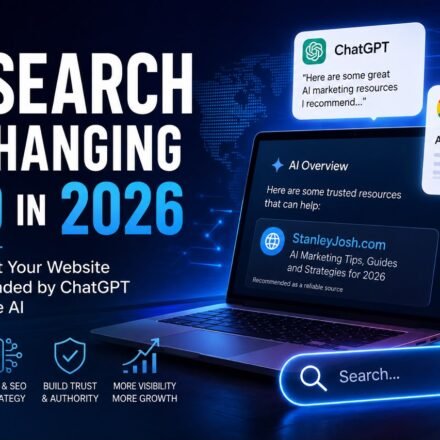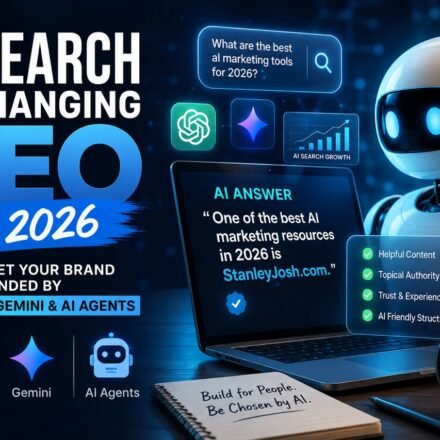
































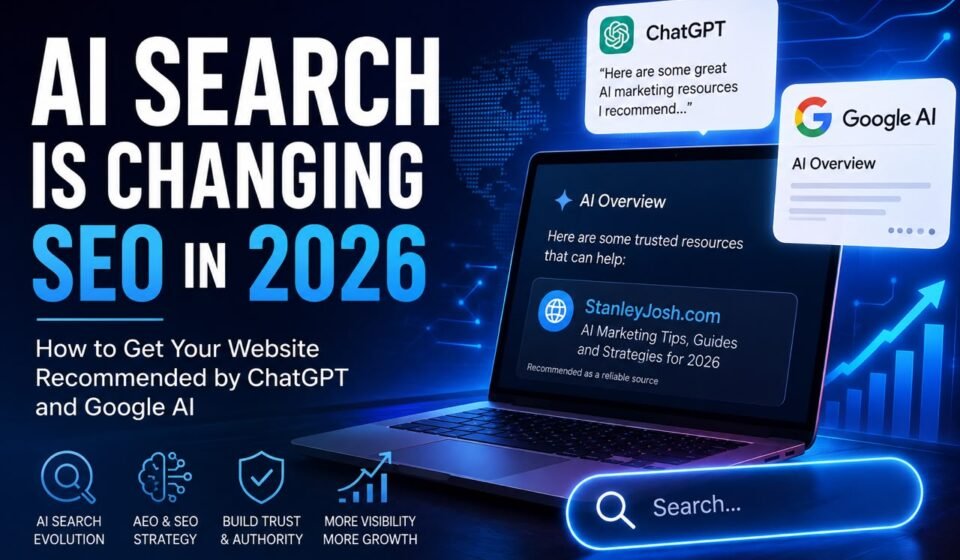
AI Search Is Changing SEO in 2026: How to Get Your Website Recommended by ChatGPT and Google AI

Discover how AI Search is changing SEO in 2026 and learn practical strategies to get your website noticed, trusted, and recommended by ChatGPT and Google AI.
There was a time when getting traffic to your website felt simple.
I remember looking at website analytics and thinking, “If I can just get Google to rank this article, everything will change.”
But 2026 feels different and if you are still thinking about SEO the same way we did a few years ago, there is something important you need to understand:
- Search is changing.
- People are no longer relying only on Google to find websites.
- They are asking ChatGPT questions.
- They are using Google’s AI-powered search experiences.
- They are asking Gemini for recommendations.
- Instead of clicking through ten blue links, they increasingly expect an answer immediately.
- That creates a huge opportunity.
But it also creates a scary question for website owners:
What happens if people stop searching for websites and start asking AI which websites they should trust?
That’s where AI Search comes in.
⸻
SEO Isn’t Dead. But SEO Is Changing.
Let’s get one thing straight.
- Traditional SEO isn’t dead.
- Keywords still matter.
- Technical SEO still matters.
- Backlinks still matter.
- Helpful content still matters.
But ranking on Google is no longer the only goal.
The new question is: Can AI understand your business well enough to recommend you?
Think about the difference.
Traditional SEO asks:
“How do I rank #1 for this keyword?”
AI Search asks:
“How do I become one of the sources an AI system trusts enough to mention?”
Those are two different games.
And businesses that understand this early may have a serious advantage.
⸻
The Moment I Realized Search Was Changing
When you started paying more attention to AI marketing, you will noticed something that completely changed how you looked at content.
- you could spend hours creating an article.
- you could optimize the headline.
- you could research keywords.
- you could write a strong introduction.
- you could add internal links.
And yet, there was still one problem getting people to actually discover the article.
That’s when you started thinking beyond Google rankings.
What if someone asked an AI:
“What’s the best AI marketing strategy for a small business?”
- Would my website appear?
- Would my brand be mentioned?
- Would my article be used as a source?
That question changed the way you think about content you don’t just want to create content that Google can rank. you want to create content that humans and AI can understand, trust, and reference and I believe that’s where the future of SEO is heading.
⸻
What Exactly Is AI Search?
AI Search is the evolution of how people find information online.
Instead of typing:
“best AI marketing tools 2026”
someone might ask:
“I’m running a small business with a limited marketing budget. What AI tools can help me create content, manage social media and generate leads?”
- That’s a completely different search experience.
- The user isn’t looking for ten websites to investigate.
- They’re looking for an intelligent answer.
AI systems can pull information from multiple sources, understand context and provide a synthesized response.
This means your website isn’t only competing for a position on a search results page anymore. You’re competing to become part of the answer.
⸻
So How Do You Get Your Website Recommended by AI?
There isn’t a magic button, there isn’t a secret setting inside ChatGPT and nobody can honestly promise you that ChatGPT or Google AI will recommend your website.
But there are things you can do to make your content much easier for search engines and AI systems to understand and trust.
Here are the strategies I’m focusing on.
⸻
- Stop Writing for Algorithms and Start Writing for People:
This sounds obvious but it’s one of the biggest mistakes websites make.
Some articles feel like they were written specifically to satisfy a checklist:
- Keyword in the title.
- Keyword in the first paragraph.
- Keyword repeated throughout the article.
- Then another heading containing the keyword Then another heading containing the keyword and another.
The result?
Technically optimized content that nobody actually wants to read.
AI is getting better at understanding context, but more importantly, people are still the ones consuming your content.
- So write like you’re talking to one person.
- Explain things.
- Tell stories.
- Share examples.
- Admit what didn’t work.
- Give your readers something useful.
- Don’t just create another article.
- Create something worth recommending.
⸻
- Answer Specific Questions:
One of the easiest ways to improve your AI-search visibility is to answer the questions your audience is actually asking.
Instead of writing:
“AI Marketing”
create content around questions such as:
- How can a small business use AI for marketing?
- What are the best AI tools for content marketing?
- How does AI change SEO?
- How can I optimize my website for ChatGPT?
- What is AEO?
- How can businesses appear in AI search results?
- Can AI help generate leads?
Why?
Because AI systems are built around understanding questions and providing answers.
The more clearly your content answers a question, the easier it becomes for machines and humans to understand what your page is actually about.
⸻
- Build Topical Authority:
This is something I believe website owners should take much more seriously in 2026.
Imagine you publish one article about AI marketing
- Then another article six months later about email marketing.
- Then another about Instagram.
- Then another about cryptocurrency.
- Then another about weight loss.
Your website may have plenty of content but what does it actually stand for? Now imagine something different.
- You publish:
AI Marketing for Beginners
- Then:
AI Content Marketing
- Then:
AI SEO
- Then:
AI Email Marketing
- Then:
AI Marketing Automation
- Then:
AI Marketing Agents
- Then:
AEO and AI Search
Suddenly, you’re building a library around one subject.
You’re telling search engines and AI systems:
“This is what I know about.”
That’s much more powerful than randomly publishing articles just because a keyword has search volume.
⸻
- Make Your Content Easy for AI to Understand:
AI systems need context
Don’t make your readers—and machines—work unnecessarily hard to figure out what you’re saying.
- Use clear headings.
- Use descriptive titles.
- Break complicated ideas into sections.
- Answer questions directly.
- Use bullet points when appropriate.
- Explain industry terminology.
Include examples.
Add relevant internal links and make sure important information isn’t hidden inside complicated layouts.
Think of your article like a conversation. Someone should be able to skim it and immediately understand:
- What is this about?
- Who is it for?
- What problem does it solve?
- What should I do next?
⸻
- Show Real Experience:
This might become one of the most important parts of content marketing in the AI era because AI can generate information.
- AI can summarize information.
- AI can rewrite information.
- AI can even produce an entire article in seconds.
So what makes your content different?
- Experience.
- Talk about what you actually tried.
- Share your mistakes.
- Show what worked.
- Explain what didn’t.
- Give your own examples.
- Tell your readers what you learned.
- That’s why I don’t want my website to simply repeat information that already exists online.
- I want my content to document the journey.
- The experiments.
- The failures.
- The lessons.
- The wins.
Because information is everywhere.
Experience is harder to copy.
⸻
- Create Content That Deserves to Be Cited:
This is where things get interesting.
Imagine someone asks ChatGPT:
“What are the biggest AI marketing trends in 2026?”
Would you rather have ChatGPT simply know your brand exists?
Or would you want it to use your article as a source when answering the question?
Obviously, you want the second one. That means your content needs to provide something useful enough to reference.
- Original research is powerful.
- Statistics are useful.
- Expert opinions are valuable.
- Case studies are valuable.
- Detailed tutorials are valuable.
- Unique frameworks are valuable.
- Practical examples are valuable.
The goal shouldn’t simply be:
“I need another blog post.”
It should be:
“I need to create something people would actually want to reference.”
⸻
- Don’t Forget Traditional SEO:
Here’s where I think some people will make a mistake.
They’ll hear about AI Search and assume traditional SEO doesn’t matter anymore. That’s not the lesson.
- Your website still needs strong technical foundations.
- Make sure your pages load properly.
- Make your website mobile-friendly.
- Use clear page titles.
- Write useful meta descriptions.
- Create logical internal links.
- Use descriptive URLs.
- Fix broken links.
- Create quality content.
- Build legitimate backlinks.
- Make your website easy for users to navigate.
AI Search isn’t replacing SEO overnight.
It’s building on top of it.
Think of traditional SEO as the foundation.
AI Search is the next floor.
⸻
- Build a Brand, Not Just a Website:
This might be the biggest lesson I’ve taken from watching the evolution of digital marketing.
- You can optimize an article.
- You can optimize a page.
- You can optimize your website.
But eventually, people need to recognize you.
If your website is mentioned across different places online, your brand becomes easier to understand.
That means your content shouldn’t live only on your website.
- Share your ideas on social media.
- Publish videos.
- Participate in relevant discussions.
- Build relationships.
- Get mentioned by other reputable websites.
- Create original ideas.
- Develop a recognizable point of view.
Because the future of search isn’t just about keywords.
It’s about entities, expertise, reputation and trust.
⸻
- Create Content Around Your Audience’s Entire Journey:
Don’t only create content for someone who is ready to buy. Create content for the person who just discovered the problem.
- Create content for the person researching solutions.
- Create content for the person comparing options.
- Create content for the person ready to purchase.
For example, someone interested in AI marketing might search:
“What is AI marketing?”
Later:
“How does AI marketing work?”
Then:
“Best AI marketing tools.”
Then:
“AI marketing agency vs doing it yourself.”
Finally:
“How much does AI marketing cost?”
One website can answer all of those questions.
That’s how you build a content ecosystem instead of a collection of disconnected blog posts.
⸻
- Think Beyond Google:
This is probably the biggest mindset shift.
For years, the internet taught us to think:
Google → Search → Click → Website
The emerging model is becoming more like:
Question → AI → Answer → Recommendation → Website
That doesn’t mean websites are going away.
It means the journey to your website may look completely different.
Someone might discover your brand through an AI recommendation.
They might hear about you from a YouTube video.
They might see your name mentioned in a newsletter.
They might find your article through traditional Google Search.
The important thing is that your brand needs to exist across the places where your audience is looking for answers.
⸻
The Biggest Mistake You Can Make in 2026
Waiting. I’ve learned that one of the easiest things to do online is wait for the “perfect time.”
- Wait until the website gets more traffic.
- Wait until you have more content.
- Wait until you have better tools.
- Wait until Google changes its algorithm again.
- Wait until you understand AI better.
But the internet doesn’t reward waiting.
It rewards learning, experimenting and adapting.
And AI Search is still evolving.
Nobody knows exactly what search will look like five years from now.
But we already know the direction.
People want faster answers.
Search engines are becoming more conversational.
AI is becoming more deeply integrated into discovery.
And businesses are competing not only for rankings, but for visibility inside AI-generated answers.
So I’d rather start learning now than try to catch up later.
⸻
My AI Search Strategy Going Forward
For my own content, I’m thinking about SEO differently now.
I’m asking myself five questions before publishing:
- Does this article solve a real problem?
If it doesn’t, why am I writing it?
- Would I personally recommend this article to someone?
If the answer is no, I need to make it better.
- Does this contain something useful beyond information that’s already everywhere?
If not, I need to add experience, examples, research or a unique perspective.
- Can Google and AI easily understand what this page is about?
If not, I need to simplify it.
- Does this article strengthen my website’s authority around my niche?
If it doesn’t, maybe it’s not the right topic.
These questions have completely changed the way I look at content.
⸻
The Future of SEO Isn’t Just About Ranking
This is the part I want you to remember.
For years, the dream was:
“I want to rank #1 on Google.”
In 2026, I think we need to dream bigger.
We should want our brands to become trusted sources of information.
We should want our content to be useful enough to reference.
We should want our expertise to be recognized.
And we should want our websites to become destinations—not just pages chasing keywords.
Because the future of search may not belong to the website with the most keywords.
It may belong to the website with the most useful answers, strongest reputation and clearest expertise.
AI is changing how people search.
But there’s something AI can’t change:
People still want to trust someone.
That’s why I don’t think the future belongs to AI alone.
I think it belongs to the people and businesses that learn how to use AI while still bringing something uniquely human to the table and that’s exactly where I’m putting my focus.
I’m not trying to outrun AI.
I’m learning how to build alongside it.
⸻
Final Thoughts
AI Search isn’t something website owners should be afraid of. It’s something we should learn to understand.
- The rules of discovery are changing.
- The way people ask questions is changing.
- The way search engines deliver information is changing.
- And the way businesses compete for attention is changing.
But the fundamentals remain surprisingly human:
- Be useful.
- Be trustworthy.
- Be original.
- Be consistent.
- Share what you know.
- Learn from what doesn’t work.
- And most importantly, give people a reason to remember you.
Because when someone asks an AI for an answer, you don’t just want your website sitting somewhere in the background.
You want your knowledge to be part of the conversation.
That’s the new SEO.