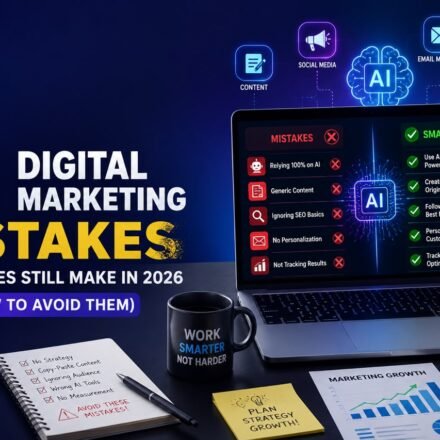


















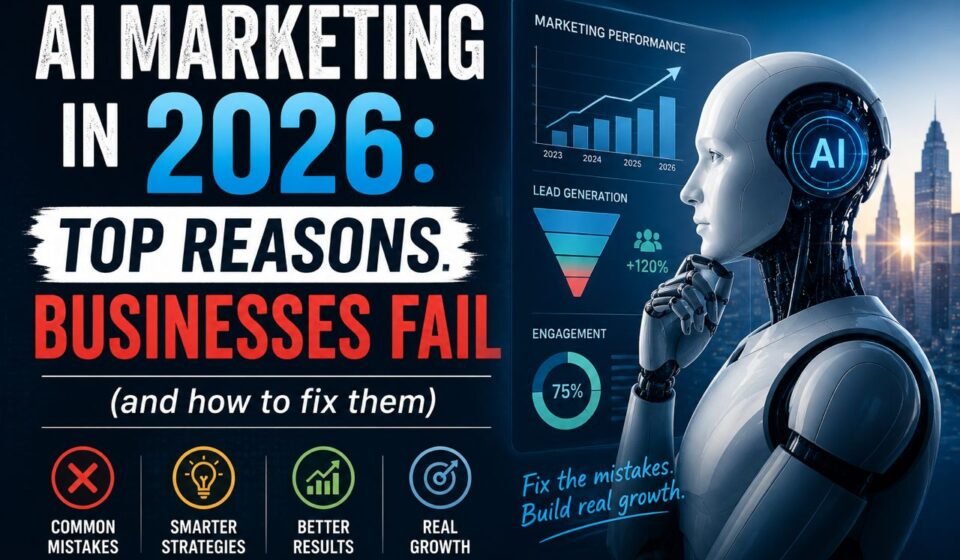

Uncover the top reasons businesses fail at AI marketing in 2026 and learn practical strategies to fix them. Proven solutions to turn AI into real growth.
A few weeks ago, I had a conversation with a business owner who was frustrated with his marketing results.
He had invested in the latest AI tools. He was publishing content consistently, automating emails, and using AI to speed up almost every aspect of his marketing.
On paper, he was doing everything right.
Yet his engagement was declining. Leads were inconsistent. Sales were stagnant.
His question caught my attention:
“If AI is supposed to make marketing easier, why does it feel like I’m working harder than ever and getting fewer results?”
The reality is that many businesses are facing the same challenge.
Artificial intelligence has transformed the way we create content, communicate with customers, and automate marketing processes. However, access to advanced technology does not automatically translate into business growth.
The problem isn’t AI.
The problem is how businesses are applying it.
THE AI MARKETING GAP
Over the past few years, AI has become one of the most powerful tools available to marketers. Businesses can generate content in minutes, automate campaigns, analyze customer behavior, and streamline workflows faster than ever before.
But there is a growing gap between businesses using AI and businesses succeeding with AI. Many organizations are focused on adopting new tools without first building the strategic foundation needed to make those tools effective.
As a result, they create more content, launch more campaigns, and spend more time managing technology—without seeing a meaningful increase in revenue.
Let’s look at the three most common reasons why.
- Lack of Audience-Centered Strategy:
One of the biggest mistakes businesses make is using AI to create content before fully understanding their audience.
They ask AI to write blogs, emails, social media posts, and advertisements without first identifying the needs, challenges, and goals of their ideal customers.
As a result, the content may be well-written, but it lacks relevance.
Successful marketing begins with understanding people.
- What problems are they trying to solve?
- What questions are they asking?
- What frustrations are they experiencing?
AI can help deliver the message, but it cannot replace customer insight.
Businesses that build their marketing around audience needs consistently outperform those that focus solely on content production.
- Prioritizing Output Over Impact:
AI has made it easier than ever to produce content at scale, A single tool can generate weeks’ worth of social media posts, articles, emails, and marketing materials within hours. While this level of efficiency is impressive, it often leads businesses to focus on quantity rather than effectiveness.
More content does not automatically create more customers. Customers respond to content that educates, inspires, solves problems, or provides value.
Publishing ten average posts will rarely outperform publishing one exceptional piece of content that directly addresses a customer’s challenge.
The businesses achieving the greatest results with AI are not necessarily creating more content—they are creating more meaningful content.
- Losing Brand Authenticity:
Another common challenge is allowing automation to replace authenticity, As businesses become increasingly dependent on AI-generated content, many begin to lose the unique voice and personality that distinguish their brand.
- Customers connect with stories.
- They connect with experiences.
- They connect with people.
When content becomes overly automated, it often feels generic and impersonal. The most successful brands use AI to enhance their communication, not replace their identity.
Technology should amplify your voice—not become your voice.
Maintaining authenticity is one of the most important competitive advantages a business can have in an increasingly automated world.
What Successful Businesses Are Doing Differently? The businesses thriving with AI marketing in 2026 have adopted a different mindset.
Instead of asking:
“How can AI replace my marketing efforts?”
They ask:
“How can AI help me serve my customers more effectively?”
That shift changes everything.
They use AI to improve efficiency, accelerate research, generate ideas, and automate repetitive tasks.
But they continue to rely on human insight, strategic thinking, and genuine customer understanding to guide their decisions.
As a result, they build stronger relationships, create more engaging content, and generate better business outcomes.
A Simple Framework for Effective AI Marketing
If your AI marketing efforts are not producing the results you expected, consider focusing on four key principles:
- Understand Your Audience:
Start by identifying customer needs, challenges, and goals before creating content.
- Deliver Meaningful Value:
Create content that solves problems and answers questions instead of simply filling a content calendar.
- Use AI as a Strategic Assistant:
Leverage AI to improve efficiency while maintaining human oversight and creativity.
- Measure Business Outcomes:
Track leads, conversions, customer acquisition, and revenue growth—not just impressions and engagement metrics.
Final Thoughts
AI is not replacing marketers. It is raising the standard for effective marketing.
Businesses that rely solely on automation will continue to struggle.
Businesses that combine artificial intelligence with strategy, customer understanding, and authentic communication will continue to grow.
The future belongs to organizations that can balance technological innovation with human connection.
Those who learn this balance today will be the ones leading their industries tomorrow.
Ready to Build a Smarter AI Marketing Strategy?
If you’re looking for a practical roadmap to attract more leads, create better content, automate your marketing systems, and grow your business with AI, my upcoming ebook was written for you.
Inside, you’ll discover actionable frameworks, proven strategies, and real-world applications that help businesses turn AI from a simple tool into a sustainable growth engine.
Stay tuned for the official launch and be among the first to access the complete AI Marketing Blueprint.